
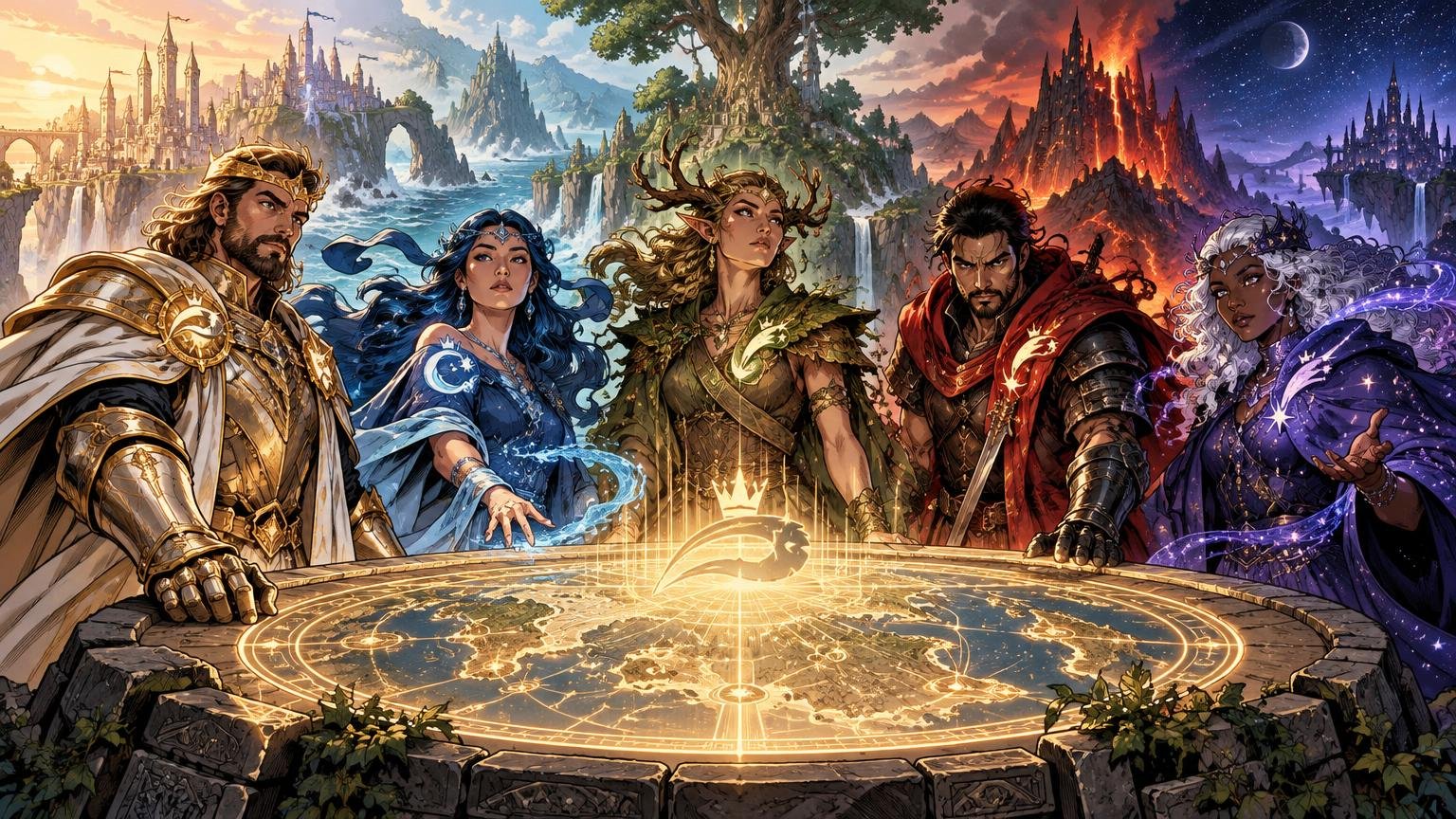
Five silhouettes stand together: one blade-thin, one mountain-heavy, one concealed by smoke, one caught in a burst of motion and one rooted like an ancient tree. Before the viewer recognizes a face, those shapes should announce five distinct legends from the same world.
The short answer: art-direct the cycle by fixing a small set of shared visual rules, then assigning each creature a different expression of those rules. Keep the world, motif language and rendering logic consistent. Vary silhouette, camera distance, dominant value, movement and environmental pressure. Consistency should make the cards feel related; it should not make them look like five costume changes in the same portrait studio.
Start with one mood and one dramatic promise
A traditional Magic cycle commonly contains five connected cards, often one in each color, with mechanical or flavor relationships between them. Shared art is possible but not required. Wizards of the Coast’s explanation of card cycles gives the structure plenty of room for visual interpretation.
Begin with a sentence describing what the complete cycle should communicate. Not lore, not five biographies: one visual promise. For example, “Five rulers hold a dying borderland together through incompatible forms of power.” That sentence gives every illustration tension, geography and a reason for the characters to differ.
Translate that promise into three visual rules. A dying borderland might use low winter light, eroded vertical architecture and one concentrated magical accent per image. Then add two exclusions: no clear blue skies and no decorative magic scattered into every corner. Exclusions are useful because fantasy art has a habit of inviting one more glowing rune until the whole kingdom resembles an enchanted pinball machine.
Choose motifs that can change shape
Recurring motifs should behave like a visual language rather than copied props. A broken-circle emblem could appear as a halo behind the white-aligned leader, a curved wake around the blue creature, a scar on the black creature, a ring of sparks around the red creature and a stone formation behind the green creature.
Give the cycle two or three motif families: a shape, a material and an atmospheric effect. For example, use broken circles, weathered metal and windblown ash. Decide which creature receives which form before illustration begins. This prevents the final card from collecting all the unused ideas like a dragon sitting on the art director’s leftovers.
Each legend still needs an individual story beat. If one card requires deeper character development, build its scene around a defining choice rather than a generic heroic stance; art-directing alternate art around a legendary creature’s story provides a focused method for finding that moment.
Build relationships between palette, value and light
Color identity can influence the palette without becoming a five-pot paint set. Choose a shared neutral family first—cold stone, dusty parchment or charcoal fog—then give each creature a controlled accent. The accents can follow the color wheel while the shared neutrals hold the world together.
Value structure matters even more at card size. Illustrator Magali Villeneuve has described beginning with a precise black-and-white sketch to test whether the concept works on the card and to establish its overall balance before color. James Gurney likewise presents value thumbnails and tonal grouping as ways to compare large light-and-dark statements before detail takes over.
Make five tiny grayscale thumbnails and place them in a row. Avoid giving every creature a bright face against a dark background. One can be a pale figure in a dark hall; another a dark mass against fire; another a middle-value silhouette interrupted by a narrow spell-light. The cycle gains rhythm when its value patterns differ but its lighting still appears to belong to the same climate or magical system.
Keep the world continuous while changing the composition
An effective brief names the location, viewpoint, action, focal subject and mood. Wizards similarly describes an art brief as supplying the card’s color and type along with its action, focus and mood. Its published art-description guidance is a useful model for turning an idea into an illustrator-ready assignment.
Write those five fields for every legend. Continuity can come from shared architecture, weather, costume construction, species design or the visible consequences of the same event. It does not require the same camera angle. Official Magic examples have followed recurring characters or themes through changing locations and predicaments while retaining a recognizable premise.
I would deliberately distribute the compositions: one close confrontation, one full-body arrival, one mounted or elevated view, one environmental wide shot and one compressed action scene. Repeating a centered waist-up portrait five times may be orderly, but it drains the cycle of scale and temperament.
Plan one controlled exception
Choose the marquee legend before rendering begins. Give that card exactly one major exception: a wider camera distance, a brighter value key, a larger environmental event or a more frontal pose. Keep the shared motif and rendering language intact so the exception reads as hierarchy rather than an accidental guest artist.
If the centerpiece needs more separation, use the controlled-exception framework in giving a boss card different art direction without breaking the set. The safest approach is to exaggerate one established variable instead of introducing a new palette, costume culture and lighting system simultaneously.
Use this mini style guide
| Decision | Cycle-wide rule | Allowed variation |
|---|---|---|
| Mood | A single emotional climate in one sentence | Each legend expresses a different response to it |
| Shape language | Two recurring geometric families | Different silhouettes and motif placements |
| Palette | One shared neutral family | One restrained accent family per card |
| Lighting | One believable world or magical logic | Direction, intensity and value key may change |
| Environment | Repeated materials, weather or architecture | Different locations and degrees of environmental dominance |
| Composition | Clear focal hierarchy at card size | Camera distance, angle and movement should vary |
| Exception | One preselected marquee card | One major rule may be stretched, not every rule discarded |
Add practical exclusions beneath the table: prohibited costume shapes, unwanted visual clichés, maximum magical accents, and any elements reserved for a specific character. Attach a small reference board showing materials, edge treatment, atmospheric density and examples of acceptable contrast. References should clarify the visual target, not invite direct copying.
Finish with a card-size contact sheet
Export all five roughs into their intended card-art crops and place them side by side. Review the contact sheet first in grayscale, then in color, and finally at physical card size. Do not judge the paintings as five large illustrations. Judge the cycle as five small decisions competing for attention.
- Can each legend be identified from silhouette and pose alone?
- Does one focal area dominate each crop?
- Do the five value patterns create rhythm rather than repetition?
- Are shared motifs visible without occupying the same position every time?
- Does the environment belong to one world while giving each character a distinct territory?
- Is the marquee card exceptional for an intentional, nameable reason?
- Does any face, weapon or spell effect disappear beneath the final frame or text area?
If two cards collapse into the same thumbnail, change the camera distance or dominant shape before polishing details. If one card feels imported from another project, bring back a shared neutral, material or atmospheric edge. For a larger mixed project, the same contact-sheet discipline can help keep multiple fantasy art styles coherent across a Cube.
Record the rules before producing final art
Condense the decisions into a reusable one-page guide: dramatic promise, three shared rules, two exclusions, motif assignments, palette swatches, lighting logic, continuity notes, five thumbnail briefs and the planned exception. That document is the cycle’s visual constitution. It should be strict enough to settle decisions and loose enough to let five legends possess five personalities.
Before using existing Magic imagery or another artist’s work, check the applicable permission or license. Wizards’ Fan Content Policy requires fan content to be unofficial and respect third-party intellectual property; it also places specific restrictions on copying, proxies and commercial use. Rights to commissioned, stock or portfolio artwork must come from the relevant rights holder rather than from that policy.
Your final decision is simple: shrink the five roughs now. If the contact sheet shows one world, five readable silhouettes and one intentional visual hierarchy, proceed to final art. If it shows five attractive strangers—or five near-identical cousins—return to the mini style guide and change the large shapes before rendering another buckle, rune or heroic eyebrow.
References
- Zen and the Art of Cycle Maintenance | MAGIC: THE GATHERING
- Secret Lair x Global Fund for Women: Their Magic Is Limitless
- Gurney Journey: Loomis's Scheme for Tonal Organization
- You Make the Card 4: Art Descriptions | MAGIC: THE GATHERING
- Cursed Commander (2017 Edition) Art Descriptions | MAGIC: THE GATHERING
- The Species of Origins, Part 2
- Fan Content Policy | Wizards of the Coast