
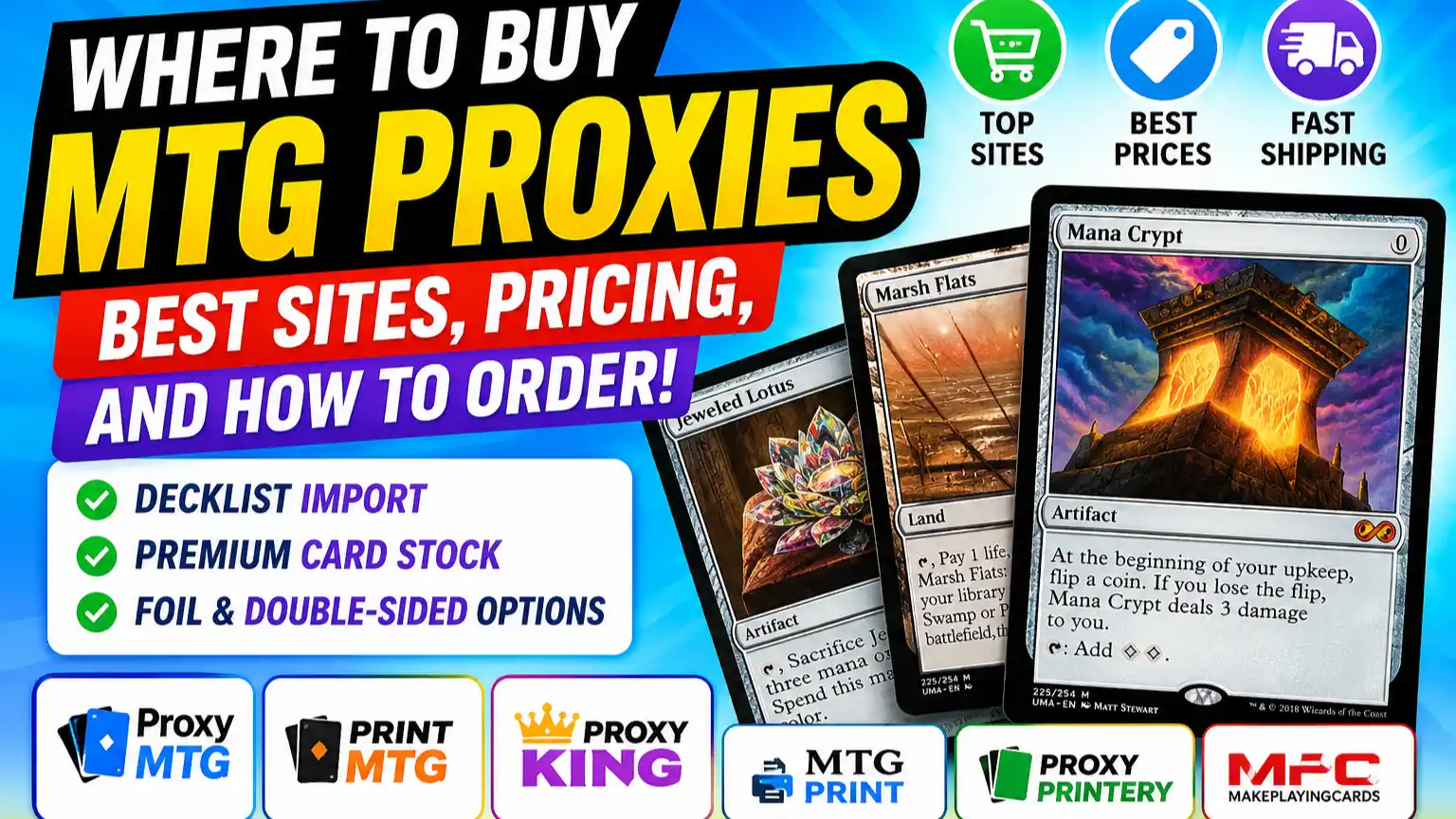
TLDR
The best site to buy MTG proxies depends on how you plan to use them. ProxyMTG.com is the best choice for bulk deck building and decklist imports. PrintMTG.com is a strong pick for high-quality finished proxies. ProxyKing.biz is best when you want realistic single staples, dual lands, or curated proxy sets.
Use MTGprint if you want free print-at-home proxies. Use ProxyPrintery if you want more stock choices, double-sided cards, or foil options. Use MakePlayingCards with MPCFill if you are comfortable with a more hands-on custom-card workflow.
Avoid PrintingProxies.com for large bulk orders if price is the main factor. Its published 200+ card tier is $0.75 per card, while ProxyMTG and PrintMTG publish lower high-volume tiers. Also skip Proxxied if your goal is buying finished cards, since it is a browser-based print-sheet tool rather than a shipped-card proxy seller.
What This Article Covers
Finding where to buy MTG proxies is simple in theory. In practice, there are a lot of different needs hiding inside that one search.
Some players want one proxy copy of an expensive Commander staple. Some want 100 cards for a new deck. Some want a full cube. Some just want a fast PDF to print at home before Friday night. And some want custom cards that look clean enough to shuffle in sleeves without feeling like printer paper.
This guide compares the best MTG proxy options by print quality, cardstock, price, ordering tools, deck import support, turnaround, and best use case. It also includes a few clear warnings, because not every proxy site is good for every buyer.
The main goal is not to find the “most realistic” proxy at any cost. The goal is to find the right proxy service for casual play, playtesting, Commander, cube, or custom deck production without wasting money.
Why Choose MTG Proxies?
MTG proxies are stand-in cards used for casual games, playtesting, cube drafts, Commander nights, and deck experiments. They let you try cards before buying real copies, protect expensive originals, and build decks that would otherwise be too expensive to test.
The most common use case is Commander. A player may want to test a better mana base, try old dual lands, build a high-power list, or avoid moving the same expensive card between five decks. Proxies make that easier.
They also help protect valuable cards. If you own expensive Magic cards, you may not want to shuffle them every week. A proxy can preserve the original while still letting you play the deck. ProxyKing describes proxies as stand-ins for original cards and notes that players often use them to avoid damaging high-value cards.
Custom cards are another reason. Many players use proxies for custom commanders, cube cards, alternate art cards, tokens, and full custom deck projects. This is where tools like MPCFill, MTGprint, and ProxyPrintery become useful.
How We Chose the Best MTG Proxy Sites
The most important factor is print quality. A good proxy should be readable, cut cleanly, and feel consistent in a sleeve. That does not mean it should be passed off as real. It means the card should be easy to play with.
Cardstock matters too. Several proxy services mention black-core cardstock because it helps block light and gives cards a more finished feel. MakePlayingCards describes S33 as a superior smooth card stock with a black-core center layer and no minimum order quantity.
Pricing matters differently depending on order size. A $3 single card is fine when you need one card. It is not fine when you need a cube. For larger orders, bulk pricing becomes one of the biggest decision points.
Ordering workflow also matters. Decklist import is a huge quality-of-life feature. Searching 8 cards by hand is fine. Searching 540 cards by hand is how hobbies become unpaid data entry.
We also looked at use case fit. Some services are better for single staples. Some are better for full decks. Some are print-at-home tools. Some are custom-card manufacturing workflows.
Best 6 Sites to Buy MTG Proxies
1. ProxyMTG.com
ProxyMTG.com is the best first stop for large-volume deck building. It is built around uploading a decklist, searching card databases, choosing versions, and printing cards on demand.
The site says users can upload a deck list or search its card database to print MTG proxies for casual play, kitchen table games, cube nights, and Commander. It also lists no minimums and free shipping over $75.
The pricing is one of the main reasons to use it. ProxyMTG lists one card at $3, then $2 per card for 2–9 cards. The price drops as quantity increases: $1.50 for 10–29, $1.25 for 30–49, $1 for 50–74, $0.80 for 75–99, $0.55 for 100–199, $0.45 for 200–499, $0.35 for 500–999, and $0.30 for 1,000+ cards.
That makes ProxyMTG especially good for Commander decks, cube updates, playtest gauntlets, and larger orders where the price per card matters.
Ordering and Import Decks
ProxyMTG’s best feature is the decklist-to-print workflow. You can upload or paste a list, review quantities and versions, and check out. The site also lets users build card-by-card with search and set browsing.
A good order process looks like this:
- Export your decklist from Moxfield, Archidekt, MTGGoldfish, or another deckbuilder.
- Paste or upload the list.
- Check card names and quantities.
- Pick the version or art you want.
- Review pricing.
- Confirm card backs, double-faced cards, and shipping.
- Place the order.
ProxyMTG says its cards are printed on S33 German black-core cardstock, receive UV coating, and are precision die cut. It also says files are enhanced to at least 300 DPI for sharper text and card details.
Double-Sided and Foil Options
ProxyMTG states that double-faced cards are printed as proper two-sided cards when selected. That is useful for MDFCs, transform cards, and other double-faced Magic designs.
Foil is less clear from its public print-proxies page. If foil-style cards matter, ask before ordering. ProxyPrintery is more direct about offering Holo Foil stock, so it may be the better fit when foil is a priority.
Best for: full Commander decks, cube updates, bulk orders, and players who want a clean ordering tool.
2. PrintMTG.com
PrintMTG.com is best for players who want a polished finished proxy order without making the process too technical. It supports printing from a decklist, starting with precons, designing custom cards, and browsing set printings.
The site’s quality pitch is straightforward: premium black-core cardstock, protective coating, clean cutting, and readable card text. It also says users can upload or paste a decklist, choose versions, review an order, and have the cards printed and shipped.
PrintMTG’s pricing is very similar to ProxyMTG’s bulk structure. It lists $2 per card for 2–9 cards, then lower tiers as the order grows, reaching $0.30 per card at 1,000+ cards.
This makes PrintMTG a good middle ground. It is easier than an MPC project, more polished than home printing, and better suited for full decks than buying one card at a time.
Best for: high-quality finished proxies, decklist printing, custom card designs, and players who want a simple checkout.
3. ProxyKing.biz
ProxyKing.biz is best for single staples and realistic proxy cards. It is less about uploading a whole deck and more about buying specific cards or curated sets.
That matters if you only need a few cards. Maybe you want a dual land set for Commander. Maybe you want a few Reserved List cards for cube. Maybe you want one expensive staple so you do not have to keep moving the real copy between decks.
ProxyKing says its proxy cards are printed and cut to normal Magic card dimensions, and its category structure includes artifact, land, green, black, blue, white, red, multicolor, and colorless MTG proxy cards. It also lists many individual cards around $4, with some foil or set products priced differently.
ProxyKing’s set catalog is one of the main reasons to consider it. Its Dual Land Set page positions the product for Commander mana bases, cube fixing, multicolor deck testing, casual play, and display where proxies are allowed.
Best for: dual lands, fetch lands, Commander staples, cube staples, Power 9-style sets, and realistic single-card purchases.
4. MTGprint
MTGprint is the best option if you want to print proxies at home. It is not a shipped-card service. It is a free tool from CardTrader that turns a Magic Arena-format decklist into a printable PDF.
This is the fastest and cheapest option for early testing. You paste a list, download the PDF, print it, cut the cards, and sleeve them in front of basic lands or bulk cards.
The downside is obvious: quality depends on your printer, paper, cutting, and sleeves. Home-printed proxies are great for testing. They are not usually what you want if you care about shuffle feel, cardstock, centering, or a clean finished deck.
Best for: quick tests, kitchen-table brewing, temporary deck changes, and players who want full control without waiting for shipping.
5. ProxyPrintery
ProxyPrintery is a strong option for players who want stock flexibility. It offers standard paper, black core, and holo foil options. It also claims prices as low as €0.29 per card, worldwide shipping, and free shipping over €50.
The biggest reason to consider ProxyPrintery is variety. It supports decklist links, Google Drive links, and MPCFill XML files. That makes it useful for custom cards, cubes, full decks, and players who already use MPCFill but want a different print provider.
ProxyPrintery says fulfillment usually takes 2–5 business days depending on order size and workload. It also says it offers double-sided cards, with a small ProxyPrintery mark added to double-sided cards on black core stock to reduce counterfeiting risk.
That last detail is good. A proxy should be playable and clear, not deceptive.
Best for: cube projects, custom cards, double-sided proxies, holo foil, black-core stock, and flexible file workflows.
6. MakePlayingCards / MPC
MakePlayingCards, usually shortened to MPC, is the best option for players who want custom full-deck production and do not mind a more involved process.
MPC is a custom card manufacturer, not an MTG-specific proxy storefront. That means you control more of the project, but you also do more of the work. MPCFill helps bridge that gap. MPCFill describes itself as a free, open-source tool for printing professional-quality playtest cards through MakePlayingCards, with a desktop tool that can download images and place the order through MPC.
MPC is best once you understand the workflow: choose images, check bleed, pick card backs, generate the files, choose stock, and submit the order. This can be cost-effective for repeat deck production, cubes, and custom projects, but it is not the fastest path for a player who only needs five cards.
Best for: custom full decks, cube projects, custom backs, repeat orders, and players who like controlling every detail.
Where to Buy Proxies: Quick Buy Sheet
| Need | Best Option | Why |
|---|---|---|
| Large decklist order | ProxyMTG.com | Strong deck tools and bulk pricing |
| High-quality finished proxies | PrintMTG.com | Good stock, simple ordering, polished output |
| Single staples | ProxyKing.biz | Easy storefront for realistic staple cards |
| Print-at-home testing | MTGprint | Free PDF workflow |
| Foil or flexible stock | ProxyPrintery | Standard, black core, holo foil, decklist and XML options |
| Custom full-deck production | MPC + MPCFill | Best for hands-on custom card projects |
| Bulk value warning | Avoid PrintingProxies.com for price-sensitive bulk | Higher published 200+ card price than some competitors |
| Finished-card warning | Avoid Proxxied for buying shipped cards | It is a browser print-sheet tool, not a shipped-card seller |
How to Place an MTG Proxy Order
Prepare Your Decklist
Start with a clean list. Export from your deckbuilder in a plain text format if possible. Include quantities. Avoid extra notes unless the site supports them.
Before uploading, check:
- Card names.
- Quantities.
- Set versions.
- Alternate arts.
- Tokens.
- Sideboard or maybeboard cards.
- Double-faced cards.
- Any custom card files.
One typo can create a wrong card. And a wrong card in a 100-card deck is exactly the kind of small problem you will notice midgame.
Import Decks and Upload Files
Use decklist import when the site supports it. ProxyMTG and PrintMTG both emphasize decklist-based ordering. ProxyPrintery supports decklist links, Google Drive links, and MPCFill XML files.
After importing, review every card. Deck import tools are helpful, not magic. Split cards, alternate names, special treatments, and double-faced cards can still need manual review.
For custom art, use high-resolution images. Avoid blurry files, cropped borders, and art that makes the rules text hard to read.
Choose Stock, Foil, and Double-Sided Options
For finished proxies, cardstock is a big part of the experience. S33 black-core stock is a common premium choice because it blocks light and gives cards a more solid feel. MakePlayingCards says its S33 stock has an extra smooth finish, a black-core center layer, and no minimum order quantity.
For foil, compare carefully. Foil looks great when it is done well, but it can add glare and cost. ProxyPrintery clearly offers Holo Foil stock, while other services may require confirmation before checkout.
For double-sided cards, make sure the service prints both sides correctly. ProxyMTG says it automatically prints both sides for selected double-faced cards, while ProxyPrintery says it offers double-sided cards with a small mark on black-core stock to prevent confusion with authentic cards.
How to Choose the Right MTG Proxy Service
Choose Based on Price Per Card
If you need one to ten cards, single-card pricing is fine. ProxyKing is convenient here because you can buy specific staples without building a whole decklist order.
If you need 100+ cards, bulk pricing matters more. ProxyMTG and PrintMTG become stronger because their pricing falls sharply at higher quantities. PrintingProxies.com lists $0.75 per card at 200+ cards, which can be much higher than ProxyMTG or PrintMTG for large orders.
Choose Based on Print Quality
Good proxies should be readable first. Sharp rules text, clean names, clear symbols, and consistent sizing matter more than flashy art.
If you care about feel, choose black-core stock or another premium playing-card stock. If you care about testing only, paper printouts are fine. Do not overbuy for a deck you might dismantle after two games.
Choose Based on Use Case
For casual Commander, use a proxy service that produces cards you enjoy playing with and that your group is comfortable with.
For serious testing, use consistent cardstock across the whole deck. You do not want one card to be obvious by touch or thickness.
For cube, consistency matters even more. A cube with mixed stocks, different cuts, and wildly different finishes can feel messy fast.
For quick testing, MTGprint is hard to beat. It is not fancy. It just gets cards onto paper quickly.
Which Option Is Best for You?
Choose ProxyMTG.com if you want deck tools, bulk pricing, S33 black-core stock, UV coating, and a simple decklist-to-print workflow.
Choose PrintMTG.com if you want a finished proxy order with strong quality, simple ordering, and good bulk pricing.
Choose ProxyKing.biz if you want realistic single staples, dual lands, fetch lands, Reserved List cards, or curated proxy sets.
Choose MTGprint if you want free print-at-home proxies and do not need professional cardstock.
Choose ProxyPrintery if you want black core, holo foil, double-sided options, custom card support, and flexible order methods.
Choose MPC with MPCFill if you want custom full-deck production and are comfortable with the setup work.
Legal Notes and Proxy Etiquette
MTG proxies are not legal in sanctioned Magic events unless a judge issues a temporary proxy for a damaged card during that event. Wizards of the Coast states that cards used in DCI-sanctioned events must be authentic Magic cards, with the damaged-card judge-issued proxy exception applying only for the duration of that event.
For casual play, the rule is social. Ask first.
Most proxy conflicts are not really about cardboard. They are about expectations. A playgroup may be fine with proxy dual lands in casual Commander. The same group may not be fine with someone bringing a fully proxied cEDH deck to a precon table.
Good proxy etiquette is simple:
- Tell people you are using proxies.
- Make sure the cards are readable.
- Use sleeves.
- Do not sell or trade proxies as authentic cards.
- Do not try to pass proxies off as real cards.
- Ask the store or organizer before bringing proxies to an event.
- Match the power level of the table.
The goal is more games, not more arguments.
Final Thoughts
The best place to buy MTG proxies depends on the balance you want between price, quality, and convenience.
ProxyMTG is the best all-around choice for bulk deck building. PrintMTG is a strong choice for clean finished orders. ProxyKing is best for single staples and realistic proxy sets. MTGprint is the easiest free print-at-home tool. ProxyPrintery is worth checking for stock variety, foil, and custom workflows. MPC is powerful for custom full-deck production, but it asks more from the buyer.
Start small if you are unsure. Order a few cards or print one test sheet before committing to an entire deck or cube. Check the cardstock, color, centering, cutting, and shuffle feel. Once you find a setup you like, save the specs so future orders are easier.
FAQs
Where is the best place to buy MTG proxies?
ProxyMTG.com is the best overall pick for deck-building tools and bulk pricing. PrintMTG.com is best for high-quality finished proxies, and ProxyKing.biz is best for single staples and realistic proxy cards.
What is the cheapest way to get MTG proxies?
The cheapest option is print-at-home with MTGprint. For finished cards, bulk services like ProxyMTG, PrintMTG, ProxyPrintery, and MPC are usually better than buying a few expensive singles.
Are MTG proxies tournament legal?
No, not in sanctioned events. Wizards of the Coast says sanctioned events require authentic Magic cards, except when a judge issues a temporary proxy for a damaged card during the event.
Is MPC better than proxy websites?
MPC can be better for custom full-deck production if you know the workflow. Proxy websites are easier for most players because they handle more of the process.
Should I use foil MTG proxies?
Use foil proxies if you like the look and your group is fine with them. For serious testing, nonfoil cards are often easier to read and less distracting.
Should proxies look realistic?
They should look clean and be readable, but they should not be used deceptively. Distinct backs, sleeves, or markings help avoid confusion.